📞  — free, 24/7
 — free, 24/7| Package | Price per Dose | Price | |
|---|---|---|---|
| 360 pills | €0,76 | €340,49 €272,39 Free shipping | |
| 180 pills | €0,83 | €187,26 €149,81 | |
| 120 pills | €0,94 | €139,97 €111,98 | |
| 90 pills | €1,00 | €111,59 €89,27 | |
| 60 pills | €1,07 | €81,33 €65,06 | |
| 30 pills | €1,17 | €43,49 €34,79 | |
| 360 pills | €0,91 | €408,60 €326,88 Free shipping | |
| 180 pills | €0,98 | €221,31 €177,05 | |
| 120 pills | €1,06 | €158,89 €127,11 | |
| 90 pills | €1,15 | €128,62 €102,90 | |
| 60 pills | €1,29 | €96,46 €77,17 | |
| 30 pills | €1,48 | €54,84 €43,87 | |
| 360 pills | €1,01 | €455,89 €364,71 Free shipping | |
| 180 pills | €1,20 | €268,61 €214,89 Free shipping | |
| 120 pills | €1,36 | €204,29 €163,43 | |
| 90 pills | €1,51 | €170,24 €136,19 | |
| 60 pills | €1,53 | €115,38 €92,30 | |
| 30 pills | €1,62 | €60,52 €48,41 | |
| 20 pills | €1,71 | €43,49 €34,79 | |
| 10 pills | €1,73 | €20,79 €16,63 |
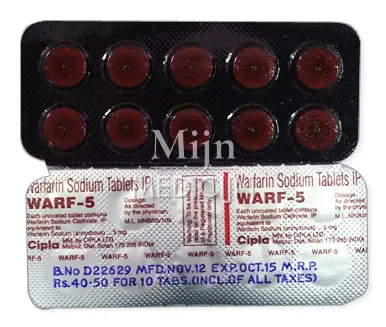
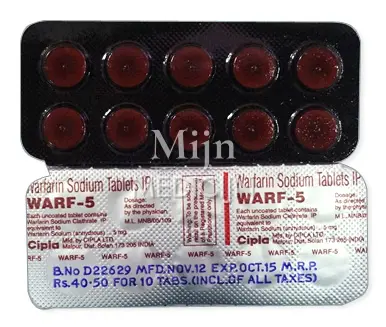
Warfarin's anticoagulant effect was first recognized after cattle hemorrhages linked to spoiled sweet clover in the 1920s; human medicine embraced it in the 1950s, and today it remains a familiar, widely used oral anticoagulant.
Warfarin belongs to the vitamin K antagonist class. It inhibits hepatic synthesis of vitamin K–dependent clotting factors II, VII, IX, and X, along with the anticoagulant proteins C and S, thereby slowing the coagulation cascade that would otherwise promote clot formation.
The drug is typically given as an oral tablet and dosed to reach a target international normalized ratio (INR) based on the condition being treated. Its effect unfolds over days and requires regular blood monitoring to maintain balance between preventing clots and avoiding bleeding.
Compared with other vitamin K antagonists such as acenocoumarol or phenprocoumon, warfarin often requires more routine INR checks and has a long track record, which supports a robust evidence base for dosing strategies and reversal approaches.
Acenocoumarol has a shorter half-life, demanding tighter dosing adjustments; phenprocoumon lasts longer and is associated with different dietary patterns and monitoring intervals in practice. These differences influence switching, perioperative planning, and patient counseling.
Pharmacogenomics and co-medications affect warfarin's performance. Variants in CYP2C9 and VKORC1 genes, plus interactions with antibiotics, antifungals, antidepressants, and NSAIDs, can markedly alter INR and require proactive clinician oversight.
Therapeutically, warfarin is used to prevent stroke in nonvalvular atrial fibrillation, to treat and prevent venous thromboembolism, and to reduce stroke risk after certain heart valve procedures where sustained anticoagulation is needed.
In mechanical heart valves, warfarin remains a standard due to demonstrated protection across long-term outcomes; newer agents have not consistently matched its efficacy in this indication.
Initiation often involves a bridging strategy with heparin when rapid anticoagulation is required, followed by maintenance dosing guided by stable INR targets. Patients receive education on dietary vitamin K consistency and monitoring schedules.
Direct oral anticoagulants (DOACs) such as apixaban and rivaroxaban offer fixed dosing and typically avoid routine INR checks, but they have limited reversal options and are not approved for all valve-related indications.
Warfarin remains favored when there are dietary fluctuations, significant drug interactions, kidney disease, or specific valve types. The choice depends on the individual risk profile, access to monitoring, and patient preferences.
| Medication | Drug class | Onset and monitoring | Reversal | Notes |
|---|---|---|---|---|
| Warfarin | Vitamin K antagonist | Onset over days; requires INR monitoring | Vitamin K or prothrombin complex concentrate (PCC) | Dietary vitamin K and drug interactions influence effect; requires regular dose adjustments |
| Apixaban | Direct oral anticoagulant | Rapid onset; no routine INR | Specific reversal agents (e.g., andexanet alfa) | Renal considerations; fixed dosing, limited valve-use indications |
| Rivaroxaban | Direct oral anticoagulant | Rapid onset; no routine INR | Specific reversal agents | Renal/hepatic function influence dosing; limited valve-use indications |
In practice, this table highlights the trade-offs between predictable dosing and the need for monitoring versus established reversal options and valve-related indications. Individual decisions depend on clinical context, access to testing, and patient values.
Bleeding risk is the principal safety concern with all anticoagulants, and warfarin is no exception. Most patients tolerate therapy well, but major bleeds—including intracranial or gastrointestinal hemorrhage—can occur, especially at higher INR levels or with interacting drugs.
INR monitoring remains central to safety, enabling dose adjustments that maintain protective anticoagulation while minimizing bleeding risk. Dietary consistency regarding vitamin K and careful antibiotic use help stabilize values and reduce surprises.
Extra care is needed in pregnancy, liver disease, or significant kidney impairment, and dosing must be individualized. Providers educate patients to recognize bleeding signs and to seek urgent care when warranted, balancing everyday life with stroke prevention goals.
14–21 days. Free from €182,34 .
5–9 days. €27,35
−10% when paying with cryptocurrency.
−10% on all repeat orders.
All orders are packed in neutral, unbranded boxes with no product name on the outside.